
 Medically reviewed by Dr. Theodore Bryan, MD, Interventional Radiology · Last updated September 2026
Prostatic artery embolization (PAE) is a minimally invasive, image-guided procedure that shrinks the prostate by reducing its blood supply — performed without cutting, without general anesthesia, and typically with a same-day recovery. It’s an option worth discussing for men who want to avoid traditional BPH surgery.
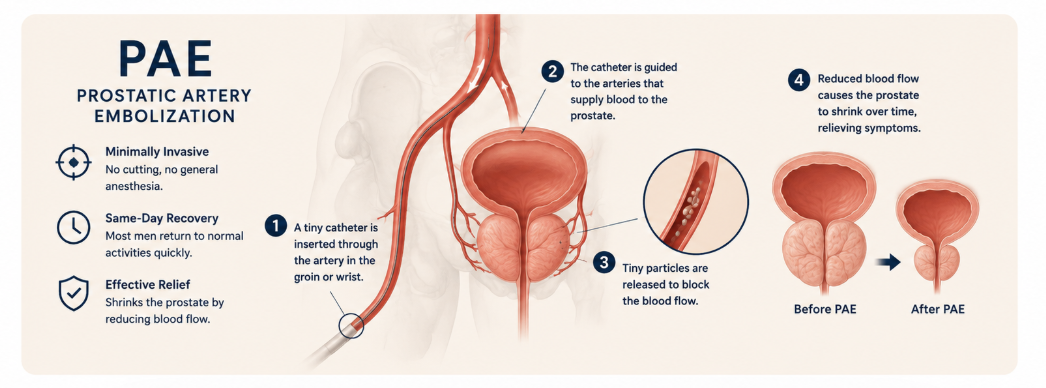
What is prostatic artery embolization (PAE)?
PAE treats an enlarged prostate from the inside out. Using a small catheter inserted through an artery in the wrist or groin, Dr. Theodore Bryan, our dual board-certified interventional radiologist, guides tiny particles into the specific blood vessels feeding the enlarged part of the prostate — working in coordination with your urologist. Blocking that blood flow causes the excess tissue to shrink gradually over the following weeks, relieving pressure on the urethra and easing BPH symptoms.
Because there’s no cutting and no removal of prostate tissue, PAE carries a notably lower risk of the sexual side effects associated with some surgical BPH treatments — a common reason patients ask about it specifically.
How the procedure works
- Performed through a single small access point in the wrist or groin — no incisions in the prostate itself.
- Local anesthesia with light sedation is used; general anesthesia is typically not required.
- Using real-time imaging, tiny embolic particles are delivered precisely to the arteries supplying the enlarged prostate tissue.
- Most patients go home the same day, often within a few hours of the procedure.
Watch: How PAE works
Who is a candidate for PAE?
PAE is often considered for men with larger prostates, men on blood thinners who may not be ideal candidates for surgical options, or men who are specifically looking to minimize the risk of sexual side effects. It’s also an option worth discussing if medication hasn’t adequately controlled symptoms, or if you’d prefer to avoid general anesthesia. As with any BPH treatment, candidacy depends on your individual anatomy and health history, which is why evaluation and imaging come before any treatment decision.
Preparing for your PAE procedure
- 48 hours before and after treatment: avoid alcohol, coffee, and caffeinated beverages.
- The day of your procedure: eat regularly, and continue taking your routine prescription medications unless instructed otherwise. There’s no need to stop blood thinners beforehand.
- Getting home: you’ll need a driver if you choose IV sedation, which is most common. In rare cases where the procedure is performed under local anesthesia only, you may be able to drive yourself.
Your healing timeline after PAE
Recovery after PAE involves temporary inflammation as the prostate shrinks. Most men don’t need a urethral catheter after the procedure, unless one was already in place beforehand.
Days 1–14, it’s common to experience: pelvic pain or pressure, burning with urination (similar to a urinary tract infection), increased urinary urgency and frequency, mild fatigue, and possibly a low-grade fever. Most discomfort improves gradually over 1–2 weeks — this is an expected part of healing, not a sign something has gone wrong.
Diet, activity & medications after PAE
- Resume your normal diet and medications, including Flomax if it’s been prescribed.
- You may drive the day after your procedure, and can generally increase activity gradually over 3–4 days.
- Avoid heavy lifting for 10 days.
- Avoid biking for 21 days.
- Sexual activity may typically resume after 10 days.
Maintaining good water intake and avoiding bladder irritants such as caffeine, carbonated drinks, and spicy or acidic foods and drinks can help minimize or prevent some urinary symptoms during recovery.
Puncture site care
PAE is performed through an artery in the groin. A small bandage covers the site, and you’re generally able to shower normally — the bandage is typically replaced daily for 3 days and removed on day 4. Bruising around the site is normal and may change color over time (red → purple → yellow → green) as it heals.
Blood in urine, stool, or semen
It’s common to notice small amounts of blood for several days after PAE. Blood in semen may last 1–2 weeks. This is generally expected and not a cause for concern on its own.
Does PAE affect erectile function?
PAE does not interfere with erectile function. Ejaculate volume may temporarily increase or decrease during the healing process.
A low-grade fever is common after PAE, occurring in about one-third of patients, and is usually caused by the treated prostate tissue breaking down rather than infection — but any fever over 101°F should still be reported to our office.
Insurance, cash-pay & financing
PAE is covered by Medicare and most major insurance plans when medically indicated, and our team manages prior authorization on your behalf. For patients without insurance coverage, the initial workup (office visit, TRUS, cystoscopy, and UroCuff) is $2,034, and cash pricing for the PAE procedure itself is discussed directly with you at your appointment. Financing is also available through CareCredit and other patient financing options, so cost doesn’t have to stand in the way of getting evaluated.
PAE frequently asked questions
Is PAE painful?
The procedure itself is performed under local anesthesia with light sedation, so most patients don’t experience significant pain during it. Some discomfort, cramping, or pelvic pain in the days following the procedure is common and generally manageable with standard pain management.
How long does PAE take?
PAE typically takes one to three hours, depending on individual anatomy, performed on an outpatient basis with most patients going home the same day.
What is post-embolization syndrome?
Post-embolization syndrome refers to a cluster of temporary symptoms — such as mild pelvic pain, urinary discomfort, or low-grade fever — that some patients experience in the days after PAE as the treated tissue responds. It’s a normal, self-limited part of recovery for many patients, not a complication.
Will I need a catheter after PAE?
Unlike some other BPH treatments, a catheter usually isn’t required after PAE, though your care team will advise based on your individual case.
Is PAE permanent?
PAE produces a lasting reduction in prostate size for most patients by permanently reducing blood flow to the treated tissue, though as with any BPH treatment, individual results and long-term symptom control can vary.
Who isn’t a good candidate for PAE?
Certain vascular anatomy, some bleeding disorders, and a few other specific medical conditions can make a patient a poorer fit for PAE. This is exactly what the evaluation and imaging process is designed to determine before any treatment decision is made.
Meet the physicians involved in your PAE care
Find out if PAE is right for you
A same-week consultation with our team is the fastest way to know whether PAE, Rezūm, or another approach fits your symptoms best.
Call or text (949) 284-2792 Or take the 2-minute I-PSS assessment first →