 Medically reviewed by Dr. Lamia Gabal, MD, FPMRS, Medical Director · Last updated September 2026
Rezūm and PAE are both minimally invasive alternatives to traditional BPH surgery, and both are offered at our practice. Neither is universally “better” — the right choice depends on your prostate size, symptoms, health history, and personal priorities. Here’s how they compare, side by side.
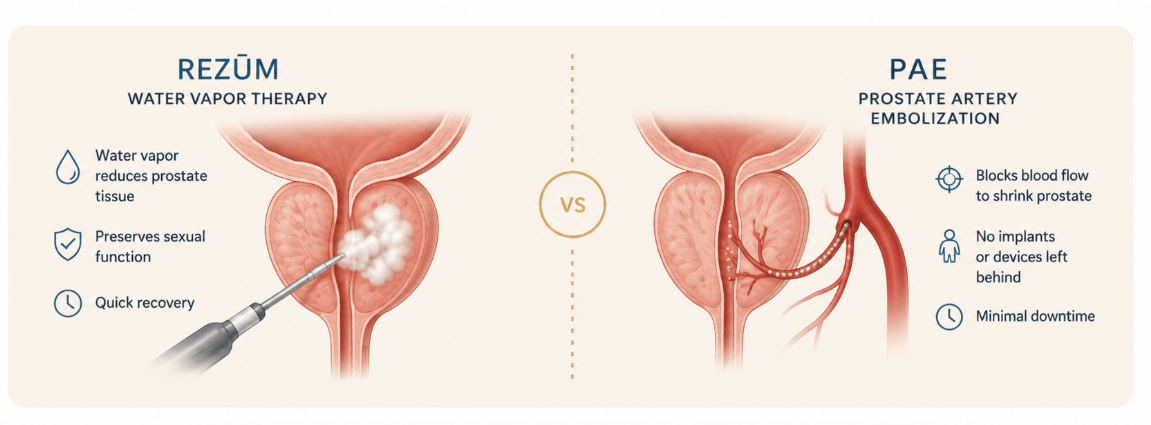
Rezūm vs. PAE at a glance
| Rezūm | PAE | |
|---|---|---|
| How it works | Water vapor thermal energy shrinks excess prostate tissue | Blocks blood supply to the enlarged prostate, causing it to shrink |
| Access point | Through the urethra, using a small scope | Through the wrist or groin, using a catheter |
| Anesthesia | Local anesthesia with light sedation | Local anesthesia with light sedation |
| Typical setting | In-office | Outpatient, image-guided |
| Catheter after procedure | Common, typically about a week | Usually not required |
| Driving | Per your doctor’s guidance after catheter removal | Typically the day after the procedure |
| Return to physical activity | Typically cleared around 2 weeks | Gradual increase over 3–4 days; heavy lifting avoided for 10 days, biking for 21 days |
| Return to sexual activity | Typically around 2 weeks | Typically around 10 days |
| Time off work | Up to 3 weeks for full recovery | Often shorter, given next-day driving and gradual activity increase — confirm with your care team based on your job type |
| Time to symptom improvement | Gradual, over several weeks, full benefit around 3 months | Gradual, most discomfort improves over 1–2 weeks |
| Sexual side effect risk | Low, compared to surgical options | Does not interfere with erectile function |
| Often considered for | A range of prostate sizes; patients wanting an in-office option | Larger prostates; patients on blood thinners |
| Insurance | Covered by Medicare and most major plans when indicated | Covered by Medicare and most major plans when indicated |
Which one tends to fit which patient?
Rezūm may be a good fit if you…
- Want an in-office procedure with a quick appointment
- Have a small-to-moderate prostate size
- Haven’t had success with medication and want to avoid its side effects
- Are comfortable with a short course of catheter use afterward
PAE may be a good fit if you…
- Have a larger prostate
- Take blood thinners and want to avoid surgical bleeding risk
- Want to avoid catheter use after the procedure
- Are prioritizing the lowest possible impact on sexual function
Frequently asked questions
Is Rezūm or PAE less invasive?
Both are considered minimally invasive compared to traditional BPH surgery. Rezūm is performed through the urethra using a small scope; PAE is performed through a small access point in the wrist or groin. Neither involves cutting into the prostate.
Does insurance cover Rezūm and PAE?
Both are covered by Medicare and most major insurance plans when medically indicated. Self-pay and financing options, including CareCredit, are also available. See our insurance and pricing page for details.
Which treatment has a faster recovery?
PAE generally has a quicker initial recovery — most patients can drive the day after the procedure and gradually increase activity over 3–4 days, though heavy lifting is avoided for 10 days and biking for 21 days. Rezūm typically involves a temporary catheter for about a week, with physical activity generally cleared around 2 weeks. Both treatments show full symptom improvement gradually over several weeks as the treated tissue responds.
When can I resume sexual activity after treatment?
Sexual activity typically resumes around 10 days after PAE and around 2 weeks after Rezūm. Neither treatment is expected to interfere with erectile function, which is one of the most common reasons patients ask about these options over other BPH treatments.
Can my doctor tell me which one is right for me?
Yes — after an in-office evaluation and imaging, Dr. Gabal or Dr. Sawkar will walk you through which option best fits your prostate size, symptoms, and health history.
Not sure which is right for you?
A same-week consultation with our team is the fastest way to know whether Rezūm, PAE, or another approach fits your symptoms best.
Call or text (949) 284-2792 Or take the 2-minute I-PSS assessment first →